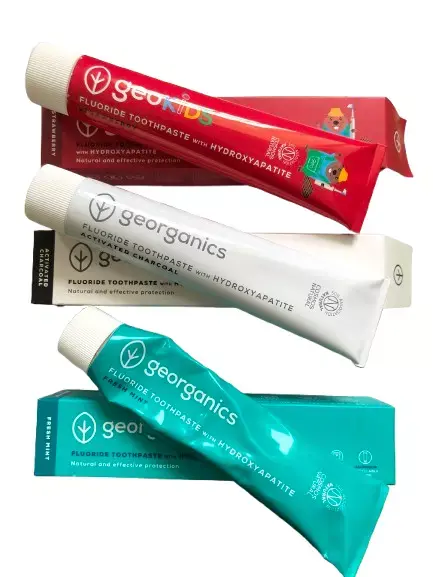

Toothpaste made with natural ingredients that would put a big toothy grin on any dentist's face, packaged in tubes made out of recycled aluminium, almost plastic-free apart from the lid, plus it truly tastes like toothpaste should?! My oh my, this could be a game-changer. If you never quite got the hang of Denttabs, then this is the sustainable toothpaste switch for you, my friend!
75ml
Choose from:
- Fresh Mint Toothpaste
- Activated Charcoal Toothpaste
- Kids Strawberry Toothpaste
These tubes of toothpaste are all COSMOS Natural certified, 100% Vegan & Cruelty-Free. Each version contains Hydroxyapatite, Erythritol, Xylitol, and, importantly, Fluoride (1350ppm) – all dentist-approved ingredients that keep those teeth of yours healthy and strong. (Read more about these ingredients in the “Extra info about the ingredients” sections.)
Bonus features – All versions are suitable for sensitive teeth. Plus, the activated charcoal toothpaste helps keep them gnashers nice and white, whilst the kids’ toothpaste is a gentle formula for milk teeth and those young gums, and is safe for kids aged 3 and over.
The mint and charcoal versions taste like Trebor’s extra strong mints, whilst the strawberry version tastes like, you guessed it, strawberries. Classic.
Please note, while I do not yet have a photo of this, the charcoal version is charcoal coloured, which is highly entertaining as it looks very weird cleaning your teeth with dark grey toothpaste. Gives you a chance to creep out the people you share a bathroom with...
Packaging: The tubes are made from recycled aluminium and can be recycled in turn. Aluminium is widely recycled, so these can go in your at-home recycling bins. The lids, unfortunately, are still plastic. So, please be aware that these toothpastes are not entirely a plastic-free product!
Toothpaste in Recycled Aluminium Tubes
Plastic tubes of toothpaste, which are notoriously unrecyclable (despite some brands trying to team up with TerraCycle and provide some kind of recycling service… which, despite good intentions, doesn’t really cut it, as the consumer has to go out of their way to recycle what is an everyday product).
Whilst ABP already sells a fully plastic-free toothpaste option (Denttabs, which is ABP’s runaway best-selling product ever since I started stocking them in 2018, nothing else has ever lived up to the same hype!), not everyone gets on with toothpaste tablets, as they are a different teeth cleaning experience that not all of you are on board for. After many years of basically being a specialist eco dental care products shop, I know that we can be very particular about what goes in our mouths… (choose your theory - Freudian oral fixation or plain individual taste differences?). Luckily, I have finally found a more sustainable toothpaste option that should suit even those who can’t handle anything that varies from the toothpaste they are used to. *Claps hands together in satisfaction*
The only downside to these toothpaste tubes is that they still have a plastic lid… but, as stated, I know toothpaste tablets aren’t to everyone’s taste, so stocking an alternative such as this, that is more like-for-like with the original product, has a place on ABP’s shelves.
I (of course) questioned my supplier, as I was disappointed to learn the lid would be plastic, and so I asked why they didn’t go the whole hog and make this toothpaste fully plastic-free. Georganics, my supplier, told me that “The plastic cap was inevitable. It's possible to have something in wood, but the inside is in plastic anyway. We looked everywhere for an alternative but could not find one that was suitable. If we find an alternative to make it 100% plastic-free, we will definitely switch, but to date, we haven't found anything suitable.” So, we can hold out hope that, in future, they may switch the lid if a plastic-free option is found that is viable for the use of this product.
Made with natural, teeth-friendly ingredients, including fluoride and hydroxyapatite to make your dentist smile, suitable for vegans, made in the UK, and packaged in a recycled aluminium tube, plus it actually tastes like toothpaste should do?! Jackpot!
My supplier told me, “The toothpaste has been received extremely well and is selling like crazy. We are super happy about the launch. The feedback is very positive to date.” This is unsurprising, as they’ve done a fantastic job of creating a more sustainable toothpaste option which really does taste like, and has the mouth feel of, what we expect toothpaste to be like. Bravo!
This is the kind of product which makes it easy to switch to the less-plastic version, as it is very similar to what you are used to already. This makes keeping up a new habit easier, as you don’t have to get used to as much difference. Easy win for ya’ll.
At 75ml, this is a fairly slimline tube of toothpaste. When I tested this product out, a tube of toothpaste lasted 1 month with 2 people using it. That is just a benchmark amount of time, based on my household’s usage, which should give you an idea of how long this product will last. If you know you are quite liberal with your toothpaste dollops, or conversely, are conservative with your toothpaste - using only tiny blobs, then this tube may last less or more time than my testing of it.
If my benchmark time holds true for you, then this toothpaste, at £4.50 a tube, is slightly cheaper than Denttabs. But… it isn’t fully plastic-free, and therein lies the trade-off.
Obviously, this toothpaste is far more expensive than your average brand found in your local supermarket, but for being almost plastic-free, housed in a recycled aluminium tube, and containing over 99% natural ingredients, this is a darn good price!
Fresh Mint Toothpaste:
Aqua*, Calcium Carbonate*, Erythritol*, Xylitol*, Glycerin*, Cocos Nucifera Oil*, Mentha Piperita Oil*, Hydroxyapatite*, Xantham Gum*, Menthol*, Sodium Fluoride(1350ppm). Ingredients: * = Natural. Of total: 99.865% Natural Origin.
Activated Charcoal Toothpaste:
Aqua*, Calcium Carbonate*, Erythritol*, Xylitol*, Glycerin*, Cocos Nucifera Oil*, Mentha Piperita Oil*, Hydroxyapatite*, Xantham Gum*, Activated Charcoal*, Menthol*, Sodium Fluoride(1350ppm). Ingredients: * = Natural. Of total: 99.865% Natural Origin.
Kids Strawberry Toothpaste:
Aqua*, Calcium Carbonate*, Erythritol*, Xylitol*, Glycerin*, Cocos Nucifera Oil*, Natural Strawberry Flavour*, Hydroxyapatite*, Xantham Gum*, Sodium Benzoate, Sodium Fluoride(1350ppm). Ingredients: * = Natural. Of total: 99.365% Natural Origin.
Packaging:
Aluminium Tube^, HDPE Lid^, Cardboard Box^*. ^Widely Recyclable, *Compostable.
Where do these products come from?
Georganics manufactures its products in-house at its Sussex-based production facility in the UK.
Are they sustainable?
Georganics states that “By consistently opting for locally sourced raw materials whenever possible, or as close to home as feasible, we reduce carbon emissions associated with transportation and support local economies.”
Packaging: Georganics sources its cardboard from a Swiss, FSC-certified supplier. The packaging is printed with vegetable inks and comes from a UK source.
Their toothpaste tubes are made from recycled aluminium, in tubes that are “also specifically designed for cosmetic use, ensuring that the toothpaste never comes into direct contact with the metal.”
How about ethical?
Georganics has certifications to back up its claims, including “The Vegan Trademark” and “Cruelty Free International”, which stamp this supplier as vegan-friendly and its products as free from animal testing. It also holds a “Cosmos Natural” certification from the Soil Association, which covers ingredients labelled as organic and/or natural.
Georganics states, “When selecting ingredients, we meticulously consider three key elements: efficacy, sustainability, and traceability. We refuse to compromise on any of these aspects. This approach enables us to collaborate with the best suppliers for the finest quality ingredients. We exclusively use natural ingredients free from chemicals that are ethically sourced (exclusively from suppliers based in the UK) and fully traceable. Moreover, we ensure that our formulations undergo collaborative development by scientists and specialists, and they are dentist-approved to guarantee their effectiveness.”
Extra good stuff:
Georganics is an Ethical Consumer “Best Buy”.
If you haven’t heard of Ethical Consumer before, and you’ve got this far down the product page, you are missing out. Go have a look as it will be right up your street! (I should know, as, full disclosure, I also work for them part-time, and, if you enjoy my nerdy ramblings, you’ll find a whole lot more of that at Ethical Consumer… except their nerdy ramblings are far more professional. 😉)
Conclusion –
A nearly plastic-free toothpaste option that tastes like toothpaste, how novel! Whether you like the extra strong minty freshness of the fresh mint toothpaste or are entertained by brushing your teeth with charcoal-coloured toothpaste, or you and your children like the sweet strawberry taste of the kids’ toothpaste, these tubes of toothpaste will keep your pearly whites nice alright. Does toothpaste even get more exciting than this??
What are they made from?
Aqua = Water. Surely you know that?
Calcium Carbonate – Calcium carbonate is an ingredient in many cleaning and personal use products, not just ‘all natural’ ones either, as it is used as a scrubbing agent. Around 4% of the Earth’s crust is calcium carbonate. It is pretty much everywhere. Industrial sources of calcium carbonate are quarried from the likes of limestone, chalk and marble. You can get calcium carbonate from things like egg shells, seashells and dark green veg like kale, but not enough for it to be worth processing for use on an industrial scale, so vegans rest assured. (Although limestone is just fossilised shells compressed over millions of years… so it kinda is an animal by-product if you wanna get technical about it, but that kind of thinking will send you insane, so forget I said anything.) We humans use far less calcium carbonate than what is produced (by all those shells and skeletons), so the ‘replenishment rate’ is much higher than our greedy consumption of it, thankfully. This even means it can technically be classed as a renewable resource, just with a very long replenishment time. Quarrying isn’t the most environmentally friendly practice, as noted by the British Calcium Carbonates Federation - ‘Quarrying activities are often more challenging to manage from an environmental perspective than other manufacturing industries and calcium carbonate producers accept their operations can potentially impact upon the environment in a number of ways.’ You know what they say, the first step to resolving a problem is admitting you have one, so the BCCF are on their way and is taking steps to mitigate its impact. (I am personally not against quarrying as such… for a climber such as meself, quarries are pretty fun once the actual quarrying has finished. Some of our best crags in the UK are old quarries, so I won’t knock ‘em unless I fall off.)
Erythritol – A sugar alcohol. Before we look too harshly at Erythritol for those triggering words – sugar and alcohol, you should know that sugar alcohols are not really what we would think of as sugar or alcohol. They are organic compounds and can be known as polyols, although they do have a natural sweetness to them, which is why they are good alternatives to sugar. Erythritol can be naturally occurring, but is mass produced by synthesising it, mostly from corn, using some enzymes and fermentation. It doesn’t affect blood sugar and insulin levels, so it is safe for those with type 2 diabetes. Like many sugar alcohols, it has a cooling effect, similar properties that mint provides. It is “non-cariogenic” (as in dental caries, the fancy way of saying rotten teeth), which means it doesn’t contribute to tooth decay, hurray, but instead helps prevent it, as it has anti-bacterial properties which stop the bacteria from reproducing and attacking your teeth.
Xylitol – More well-known than Erythritol, you might recognise this ingredient by associating it with chewing gum. Part of its let’s say, charm, is that it helps you produce more salvia. Industrially produced from wood or the agricultural waste by-products (the discarded inedible bits) of crops such as wheat or rice. It can also be produced by fermentation. It is also naturally occurring in some plants. It is a type of sugar alcohol and is often used as a sugar substitute. Same as Erythritol, it is beneficial for dental health, as it reduces the levels of bad bacteria living in your mouth (don’t think too much about what lives in your mouth, that way madness lies). It also helps stop these nasties from sticking to your teeth and reduces their ability to produce acid and thus corrode your teeth. Oddly, it is toxic to dogs and ferrets, but it is safe for rhesus macaques, horses, and rats, whilst they aren’t sure about cats. Sadly, one can guess how they found that out based on the animals involved, though I wouldn’t like to dwell on that overly much, as we can’t do anything about that now. Lesson to take away: Don’t let your pets eat toothpaste! …And you shouldn’t eat it either, as apparently excessive xylitol intake can produce a *ahem* laxative effect in humans.
Glycerin – As these are vegan products, we can safely say this is vegetable glycerine, which is derived from vegetable matter, generally plants such as soy, coconut or palm, to name a few. Determining the exact source of the glycerine isn’t always obvious, but I shall endeavour to find out and report back. Vegetable glycerine can be used as an ingredient in food, but in this case, where it is being used in a personal care product, it is used to make the product smoother and helps keep it moist, so it doesn’t dry up so quickly.
Cocos Nucifera Oil - Coconut Oil – Coconut oil is extracted either using dry or wet processing methods. Dry processing means using the fleshy bit as is, and the oil is pressed out or dissolved in a solvent, whilst wet processing uses the coconut milk to extract the oil, by separating the oil and water emulsion. Wet processing is more energy-intensive and produces less yield than dry processing, so the energy-efficient dry method is usually the preferred method of extraction. As with any oils, you need a lot of coconuts to produce a good amount of coconut oil. You need 1000 coconuts for approximately 70 litres of coconut oil.
Coconut oil itself is edible and is pressed out of the kernel/’flesh’ (the white bit) of a full-grown fruit. Coconut oil also has a lot of fatty acids in its makeup, so it is often used in beauty and cosmetic products for its moisturising ability.
Coconut trees happily grow by themselves, generally without the need for pesticides or herbicides and are harvested by hand. Monoculture plantations of coconuts are becoming more common as demand for this product increases, and as we all know, monocultures don’t tend to do the soil a lot of good. However, coconut trees can grow in sand and have a high tolerance to salinity (makes sense growing up by the sea). This is generally land which is unable to grow any other farmable produce, and which doesn’t have many other species that grow on it. This means it avoids a lot of the deforestation problems that other oils, such as palm* and soy, do, although coconut tree plantations can encroach on important habitats such as mangroves.
Coconut trees grow in tropical climates, which means there is a bigger carbon footprint using this oil as opposed to locally grown oils like rapeseed oil. There are also potential animal rights problems with coconut harvesting, as in Thailand, monkeys have been traditionally trained to pick coconuts instead of using human harvesters, which has led to some ‘slave monkey’ concerns. Monkeys are much better at picking coconuts than humans, as you could guess, and they don’t need to be paid, unlike humans, and are far less likely to fall out of the tree and injure themselves, so you can see why this practice began. After a lot of outrage recently concerning this issue over the welfare of these monkeys, including boycotts of monkey-picked products in many Western countries, officials in Thailand are attempting to create a traceability system so that consumers can be sure that their coconuts are picked properly. Outrage is bad for business, so steps are being taken to stop coconut producers from monkeying around.
*Yes, coconut trees are referred to as palm trees, but they are a different type of palm than the palm palm oil comes from. I’m not palming you off, honest. *facepalm*.
Mentha Piperita Oil - Peppermint oil. Essential oils - Essential oil production generally uses steam distillation, which has no environmental concerns, but it takes a lot of plants to make only a small amount of essential oil.
Hydroxyapatite – the new buzzword in dentistry. It’s a mineral that is a naturally occurring form of calcium apatite. Calcium…makes you think of bones, doesn’t it, and you’d be right, as much of human bone is made up of a kind of Hydroxyapatite, as is dental enamel and dentin – no wonder it's good for your teeth! Hydroxyapatite can be synthetically produced nowadays, which is why it is suddenly a big thing for dentists to get excited about, as it helps remineralise your teeth. :D It can also reduce tooth sensitivity by helping to heal micro-cracks in your tooth surface, and may even make your teeth whiter to boot. It is a very recent development in tooth health; the European Commission's Scientific Committee on Consumer Safety (SCCS) only first stated it was safe to use in toothpastes in 2021. Although this does mean it lacks the long-term studies on dental health that the gold standard toothpaste ingredient, fluoride, does. However, as Hydroxyapatite is biocompatible, it’s something already in our bones after all, so this isn’t something experts seem to be worried about. There are lots of studies already on the effectiveness of Hydroxyapatite, and what does get those experts raving is over its amazing remineralisation of teeth! Here is a roundup of those studies for those who want to get real nerdy.
A fun side note is that a mantis shrimp’s (arms? appendages?) “clubs” are made of a type of Hydroxyapatite, and they have the fastest punch of any animal, with the speed of a bullet. Anyway, those guns (as in arms) are super strong, so always name one as your second if challenged to a duel… although they have been known to break aquarium glass by punching through it.
Xanthan Gum – Acts as a binding agent and thickener. It is made by fermenting sugars such as glucose by a particular strain of bacteria. The feedstock for the bacteria can often be made of ‘waste’ from the food industry, such as whey, which is a waste product of cheese production. In terms of its environmental impact, it seems fine, plenty of bacteria to help make it, and there are studies showing that it is an eco-friendly way to help stabilise peat and soil (instead of cement or lime). Which makes it seem as if it probably won’t be harmful if it escapes into the environment. Again, not a lot of information on xanthan gum’s environmental impact.
Menthol - It can be made naturally from mint oils or created synthetically. I can’t find any information that states the environmental impact of menthol, so it should be ok.
Sodium Fluoride – The one that causes a load of debate, but shouldn’t. Sodium fluoride helps prevent tooth cavities. Ingestion, such as drinking fluorinated water, is less effective than topical application, i.e. by using toothpaste. There is a long-established historical basis for claiming the benefits of fluoride for dental health. Despite this, there are lots of claims that ‘It’s toxic!!’ Well, of course it is… in high doses. Nearly everything is toxic in high doses, so don’t get worked up about it, unless you only eat toothpaste and nothing else for some reason. (Note - Children should be exposed to less fluoride than adults, though, as their tolerance is much lower whilst they have their baby teeth. Once you have your adult teeth, this is no longer a problem, so stop panicking.) Fluoride is naturally found in nearly everything, it seems, be that rocks, soil and in nearly all water sources throughout the world, and places that don’t have much fluoride in their water often add it to public water sources to spare us excess trips to the dentist. Some countries add it to salt instead. How thoughtful. Fluorination of water is one of the biggest public health initiatives in the world and has saved a lot of toothache. Unless you live in an area with an excessively high level of fluoride in the local water sources, most people are very, very unlikely to intake enough fluoride from drinking water, eating food, brushing their teeth and breathing, etc., to cause harm.
Lots of studies have been done on the acute toxicity of fluoride for terrestrial and aquatic animals as well as plants. Harm has been found to be caused to organisms within a close range of places where fluoride is used for industrial purposes, such as aluminium smelters or brickworks. However, other pollutants emitted from these factories are likely to cause similar problems, so it is not entirely verified whether fluoride alone causes these problems due to these compounding factors. For freshwater organisms, fluoride levels can be increased to toxic levels by human sources, and this can depend on water hardness. Again, other human effluence could also contribute to this kind of pollution. More work needs to be done to properly assess whether human sources are leading to environmental pollution and how to prevent this, but evidence seems to suggest so far that industrial uses of fluoride (not just sodium fluoride, but calcium fluoride, hydrogen fluoride, etc.) present a greater risk of becoming a pollutant.
If you would like more information, this is my source compiled by experts and published by the United Nations Environment Programme, the International Labour Organisation and the World Health Organisation, and produced within the framework of the Inter-Organisation Programme for the Sound Management of Chemicals.’ If you can’t believe these lot, then I’m afraid I can’t help you further. http://www.inchem.org/documents/ehc/ehc/ehc227.htm#1.0
p.s. If anyone is a candidate for fluorosis, it’s me, as I’ve spent at least 7 years breathing in the dust from Denttabs toothpaste tablets when packaging those up, as well as, obviously, cleaning my teeth twice a day, too. Needless to say, I am not yet stricken, and you would be hard pressed to find someone in the UK as exposed to as much fluoride as I am. I also have never had a filling, though I shan’t be as bold as to admit cause and effect without proper scientific practice. In the meantime, I shall continue to be a potential living case study.
Kids' toothpaste specific ingredients:
Natural Strawberry Flavour – Note the “natural”, this means that the flavouring has been extracted from the actual botanical source material, strawberries, rather than being the bizarre mixture of chemicals that makes up synthetic ‘strawberry’ flavouring (which oddly tastes not that much like a real strawberry).
Sodium Benzoate – Used as a food preservative, which prevents bacteria from growing. It is the sodium salt of benzoic acid, and although it is typically artificially produced, it is also naturally occurring in many fruits and vegetables. As this ingredient is limited to the kid’s strawberry toothpaste, and the adults versions does not include this ingredient, it is possible it either appears due to the strawberry flavouring, or, is required because of it, as sometimes this ingredient is used to protect the taste of foods which would otherwise diminish over time. I’ll find out and update this info section once I’ve found out!
Activated charcoal toothpaste specific ingredients:
Activated charcoal – Is known for its ability to absorb impurities (well, technically it is adsorption, which means gases or liquids stick to the surface of the charcoal because charcoal has a massive surface area, making it very porous) and for its colouring. Activated charcoal seems to be in every other health/beauty product right now, as charcoal is so good at purifying, e.g. adsorbing sebum from your oily skin, and it also is very safe as an ingredient, as well as having that ‘natural ingredient’ vibe that everyone loves. But is it eco-friendly and sustainable? Well, charcoal is basically what you get when you burn wood. Which doesn’t make it sound so eco-friendly from the offset, I mean outset. Most activated charcoal is obtained from burning bamboo, however, rather than hardwoods or softwoods. As bamboo is a fast-growing and sustainable plant, this is the best choice for charcoal. Charcoal is used in wastewater treatment plants to absorb impurities, and it can be used to improve air quality as it absorbs things like heavy metals and dioxins* from exhaust fumes. Pretty handy with all the air pollution kicking around. So, although it seems as if charcoal isn’t so eco-friendly (burning wood contributes to air pollution after all), at least it is part of the solution too!
*Dioxins are POPs, which sounds fun, but stands for ‘persistent organic pollutants’, which definitely isn’t what you would call fun. They are highly toxic and accumulate in fatty tissues, where they hang around for a long time. Nasty stuff.